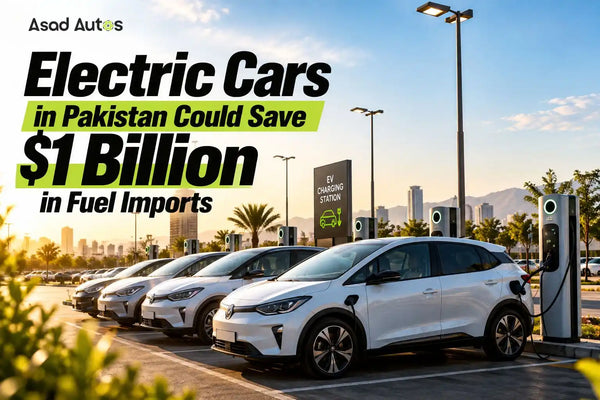
The EV tax in Pakistan stays favourable for another two years. The FBR has confirmed that the sales tax exemption on CKD kits and the 1% sales tax on eligible electric vehicles continue until 30 June 2027.
Luxury EVs are treated differently, with Federal Excise Duty of 30% and 40% applying above set value thresholds.
Here's what's been clarified and what it means if you're buying, assembling or importing.
FBR Confirms EV Tax Concessions Until June 2027
The clarification matters more than it might sound. Uncertainty about whether a concession will survive the next budget is enough to stall investment decisions on its own, regardless of what the rate actually is.
A confirmed end date gives manufacturers and buyers a two-year window to plan against. Official documents are published by the Federal Board of Revenue.
EV CKD Kit Tax Exemption Extended to June 2027
CKD — completely knocked down kits are vehicles imported in parts and assembled locally. The sales tax exemption on these kits for EVs runs to 30 June 2027.
This is the provision aimed at local assembly rather than at buyers directly. It lowers the cost of building EVs here relative to importing finished vehicles, which is the entire point.
The effect shows up in projects like BYD in Pakistan, where local production changes the pricing maths considerably.
1% Sales Tax on Eligible EVs Continues
Eligible electric vehicles continue to attract sales tax at 1%, covering electric cars, buses and trucks.
Against the standard rate applied to conventional vehicles, that's a substantial gap — and it's the single biggest reason mainstream EVs are priced as competitively as they are locally.
Models in the mainstream segment, like the BYD Atto 3 Evo, sit well below the luxury thresholds discussed next.
Luxury EVs Face 30% and 40% FED
Above certain values, Federal Excise Duty applies:
| Vehicle Value | FED Rate |
|---|---|
| Above $75,000 | 30% |
| Above $110,000 | 40% |
The logic is straightforward: keep affordable EVs cheap and tax the expensive ones. A buyer choosing a premium imported EV isn't the person the concession was designed for, and the FED reflects that.
What the New EV Tax Rules Mean for Buyers
For most buyers, nothing changes and that's the useful part. A locally assembled or eligible EV keeps its favourable treatment through June 2027.
If you're looking at a premium imported EV, the FED thresholds are worth checking before committing. The difference between falling just under or just over a threshold is significant.
Tax is only one part of the decision, of course. Our guide to EV technology in Pakistan covers charging, running costs and the practical questions that matter alongside price.
What the FBR Clarification Means for Pakistan's EV Market
Policy continuity is what assembly investment needs. Setting up local production takes years, and nobody commits that capital against a concession that might disappear at the next budget.
Two years of certainty is short by manufacturing standards but far better than none.
Demand is moving in the same direction, with rising fuel costs pushing more buyers toward EVs in Pakistan than at any point previously.
Final Takeaway
The EV tax in Pakistan remains favourable until 30 June 2027 CKD exemption intact, 1% sales tax on eligible vehicles, and FED reserved for the expensive end of the market. What happens after that date hasn't been decided, so anyone planning around the concession should treat June 2027 as a real deadline rather than an assumption. Tax aside, charging remains the other half of the equation our guide to EV charging stations in Pakistan covers where the network stands.
Note: General information only, not tax advice. Rates and eligibility depend on vehicle classification, import status and assessed value, and can be revised. Verify your position with the FBR or a qualified tax professional before purchase.
15+ years in business · In-house fitting in Multan · Nationwide delivery · Exact-fit products, never universal
Browse All Car Accessories →Questions about what fits your car? Contact us — 0321-1117525 · Open Mon–Sun, 9am–9pm.