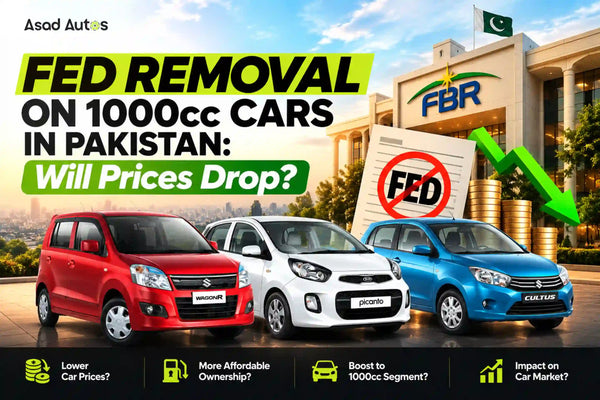
Pakistan's proposed 1000cc car parts duty reduction would cut duty on eligible imported parts from 46% to 30% in FY 2026-27 a far bigger first-year cut than larger cars get.
Two things to fix in your head before the numbers. This is duty on parts, not on complete cars. And a 16-point cut on some parts is not 16% off a car's price.
What the Proposed Car Parts Duty in Pakistan Actually Is
The rate applies to imported parts in the localized category — parts in categories already manufactured in Pakistan. Both engine groups sit at 46% in FY 2025-26 as the starting point.
| Engine size | FY26-27 | FY27-28 | Later | FY30-31 |
|---|---|---|---|---|
| Up to 1000cc | 30% | 30% | 25% | 15% |
| Above 1000cc | 40% | 40% | 35% then 30% | 15% |
Proposed rates on eligible imported parts, not on complete vehicles. The first-year figures and the FY 2030-31 endpoint are clearly reported; the exact year each middle step applies is less firmly stated in the reporting, so treat the middle column as the sequence rather than a dated schedule.
16 Points Against 6 — But Both End at 15%
In the first year, cars up to 1000cc drop 16 percentage points (46 to 30). Cars above 1000cc drop 6 percentage points (46 to 40). That is roughly 2.7 times the cut for the smaller group.
Now the part being missed everywhere else. Both groups arrive at 15% in FY 2030-31.
So this is not a permanently better deal for small cars. It is front-loaded relief that converges by the end of the policy period. Small cars get there first, and by 2030-31 everyone is in the same place.
The Second Advantage Nobody Is Mentioning
The duty cut is only half of what the 1,000cc line does, and the other half is arguably bigger.
The policy carries an Automotive Development Levy expected to raise over Rs 232 billion over five years. It applies to vehicles above 1,000cc.
So a car up to 1000cc gets the much larger parts-duty cut and sits outside a levy expected to collect more than Rs 232 billion. Read together, that is not a discount for small cars — it is the policy deliberately steering buyers below the 1,000cc line.
What “Localized Parts” Actually Means
This phrase decides who the cut reaches, so it is worth a plain definition.
A localized part is one in a category already manufactured in Pakistan. Policy frameworks keep lists of these, and parts in those categories normally carry higher import duty on purpose — the point is to make importing something you could buy locally less attractive.
That is why 46% was so high to begin with. It was never a revenue rate; it was protection for local parts makers.
Which makes this proposal more interesting than a simple tax cut. Lowering duty on localized categories reduces the protection those suppliers have enjoyed, while the policy simultaneously pushes assemblers towards more local content. Those two pull in opposite directions, and how that tension resolves is the thing to watch over the five years.
Who Gets the Saving First
Not you, at least not directly. Customs duty on parts is paid by whoever imports them, which here means the vehicle assembler.
So the saving lands on an assembler's input costs. Whether any of it continues on to a buyer is a commercial decision, not an automatic consequence, and it competes with every other cost pressure the company is carrying.
That is the honest mechanism, and it explains why duty cuts and showroom prices so often fail to move together. It also explains why the export penalties in this policy matter: they are the part that actually obliges manufacturers to do something.
Will Small Cars Become Cheaper in Pakistan?
Nobody has promised that, and the arithmetic does not carry across the way people expect.
A 16-percentage-point cut on eligible parts is not a 16% cut in a car's price. It applies to some imported parts, in categories already localised, which are one input into a cost structure.
What sits between that and a showroom figure: how much of your specific model is imported versus local, every other tax and levy, the exchange rate, production and freight costs, and what the assembler chooses to pass on rather than keep.
Small cars are where most of this market actually buys — visible in Pakistan's 39 million vehicle fleet — so the pressure to pass something on is real. Real is not the same as announced.
Where the Policy Stands Right Now
This moved on Tuesday 20 October. The Prime Minister approved the draft Auto Policy 2026-31, presented to him by the law minister and the adviser on industries and production.
Two details worth holding on to. The Prime Minister's Office issued no official statement — the final draft was shared by sources. And approval of a draft is not enactment.
What remains, on the latest account: the federal cabinet for in-principle approval, and then Parliament's nod. A policy that needs a parliamentary vote is considerably further from being law than one needing only a notification.
Accounts of the remaining steps do differ earlier reporting described an IMF review and the Economic Coordination Committee in the chain. Our coverage of the IMF talks on the auto policy covers that stage. Until something is notified, every rate above is proposed.
The Export Targets Do Not Add Up
The policy sets a five-year export target of $6.01 billion across parts and vehicles. Here is the year-by-year breakdown.
| Year | Target |
|---|---|
| 2026-27 | $256.6m |
| 2027-28 | $671.8m |
| 2028-29 | $1.11bn |
| 2029-30 | $1.17bn |
| 2030-31 | $2.19bn |
| Sum of the years | about $5.40bn |
Add the five annual targets and you get roughly $5.40 billion, against a stated total of $6.01 billion a gap of about $0.61 billion. Either a year is understated or the headline total includes something the breakdown does not.
The enforcement behind those targets has more teeth than the numbers suggest. Manufacturers receive compensation worth 5% of export value, plus a further 10% on exports above the previous year's level — and manufacturing certificates can be cancelled if export targets are missed for two consecutive years.
EVs and Hybrids Are Priced Separately
For 2026-31 the draft sets different sales tax rates by drivetrain, and the distinctions matter.
Battery electric vehicles 1%. Range-extended electric vehicles 6%. Plug-in hybrids 9%. Anyone treating range-extenders and plug-in hybrids as the same thing is wrong by three percentage points according to the draft itself.
Beyond that, electric vehicles valued above $75,000 would carry a 10% federal excise duty, while those under $15,000 get lower tariffs with no rate specified.
On financing, the EV limit rises from Rs 3 million to Rs 10 million with repayment extending from three years to five. If you are weighing one up, our guide to buying an EV in Pakistan covers what to confirm first.
Final Thoughts
The 1,000cc line is doing more work in this policy than the headlines suggest. Below it you get a 16-point parts-duty cut instead of 6, and you sit outside a levy expected to raise over Rs 232 billion. That is a deliberate nudge, not a coincidence.
But both engine groups land on the same 15% by 2030-31, nothing here is a cut on complete cars, and the draft still needs the cabinet and then Parliament. Watch for the notification, not the announcement.
15+ years in business · In-house fitting in Multan · Nationwide delivery · Exact-fit products, never universal
Questions about what fits your car? Contact us — 0321-1117525 · Open Mon–Sun, 9am–9pm.