The Pakistan Auto Policy 2026-31 has still not been approved, despite a round of September headlines saying it had been.
If you have seen “PM approves auto policy” and then, weeks later, “policy may be approved today”, nothing is wrong with your memory. What was approved in September was a draft, and a draft is a long way from a rule.
What the Prime Minister Actually Approved
In early September the Prime Minister signed off on an initial draft and told officials to revise it, asking for more weight on technology transfer and on employment for skilled Pakistani workers.
Two days later, a senior official in the Prime Minister's Office put the record straight. The policy was “still being finalized”, no final decision had been made, and a formal written draft was still being prepared.
That statement was made specifically because of the reports claiming approval. It is the clearest confirmation available that the September coverage ran ahead of the facts.
The Four Gates Still Ahead
This is the part worth keeping. The Prime Minister's sign-off is not the finish line, and reporting on the process describes several stages still to come.
| Stage | When | Status |
|---|---|---|
| Previous policy expires | 30 Jun 2026 | Done |
| Committee in-principle approval | 13 Aug 2026 | Reported |
| PM approves draft, orders revisions | 9 Sep 2026 | Reported |
| IMF review of the draft | 2 Oct 2026 | Inconclusive |
| Economic Coordination Committee | — | Pending |
| Federal Cabinet | — | Pending |
| Ministry notification | — | Not issued |
Sequence as described in reporting on the process. Nothing in the policy binds a buyer, a bank or an assembler until the final notification is issued.
One number puts the delay in perspective. The previous policy expired on 30 June 2026, which means Pakistan has now gone 112 days with no auto policy in force, and reporting says manufacturers have put production and pricing decisions on hold while they wait.
Pakistan Auto Policy 2026-31: Where Things Stand Today
The Prime Minister has called a meeting to review the framework, and approval is possible if he is satisfied with it. That report is based on unnamed sources, carries no time for the meeting and quantifies nothing.
Before that meeting, an inter-ministerial committee headed by the law minister revised the draft and recommended amendments built around seven broad principles for restructuring the sector.
As of today, no formal approval and no notification has been announced. We will update this page at each stage rather than publishing a fresh article every time the story moves.
What Is Proposed on Duties and Car Prices
These are the figures attached to the draft in reporting. Every one of them is a proposal.
| Proposed measure | Reported figure |
|---|---|
| Average vehicle import taxes | 10.6% down to 7.4% by 2030 |
| Customs duty tiers | 0%, 5%, 10% and 15% |
| Duty on fully built-up imports | capped at 15% |
| Conventional vehicle customs duty | down up to 80% over five years |
| Used vehicle RD and ACD | withdrawn gradually by 2030 |
| Annual vehicle production | beyond 500,000 units |
| EVs and hybrids, share of car sales | 30% by 2031 |
Proposed in reporting on the draft. None of this is in force, and the final notification may contain different numbers or none of them.
The duty cuts also have to fit the National Tariff Policy 2025-30, which already provides for gradual reductions through 2030. That constraint is why the numbers above are phased rather than immediate.
On whether any of this reaches showroom prices: lower duties reduce one input into a price, not the price. Exchange rates, production costs, local taxes and what assemblers choose to pass on all sit in between. Treat a cheaper-cars headline as a possibility, never a commitment.
The Export Target Nobody Agrees On
Export ambition is the policy's headline selling point, and it is also where the reporting falls apart.
Figures attributed to the draft range from $1 billion in automobile exports, to $4 billion a year by 2031, to $8 billion after the Prime Minister asked for the target to be doubled.
The official who mentioned the four-billion figure described it as an example and declined to give the committee's actual numbers. So the honest position is that a target exists, it is ambitious, and its size is not public.
Why the IMF Is Involved
The draft has to go to the IMF before cabinet approval, and the reason is narrower than it sounds. Cutting import duties cuts revenue, and revenue is committed under Pakistan's 37-month, $7 billion Extended Fund Facility approved in September 2024.
Talks on 2 October were reported as inconclusive, with the IMF objecting to certain provisions. A separate $1.4 billion facility is also under review, and successful reviews could release roughly $1.2 billion.
So this is a consistency check on tariff revenue rather than a veto on affordable cars. Our coverage of the Auto Policy 2026-31 and the IMF talks goes through what was discussed.
EVs Gain, Hybrids May Lose
If you are choosing between a hybrid and an electric car right now, read this part twice, because the two are moving in opposite directions.
In mid-September the FBR cut sales tax on locally manufactured hybrids up to 2,000cc from 25% to 18%. That has already happened.
The draft policy, however, is reported to propose that existing hybrid sales-tax concessions would end, while electric vehicles gain a 1% sales tax on parts for local EV production, exemption from federal excise duty, capital value tax and advance income tax, and a 1% customs duty on charging-station inputs.
Both can be true at once: the cut is real, and the draft proposes a different direction from here. Which one survives the notification is not knowable today.
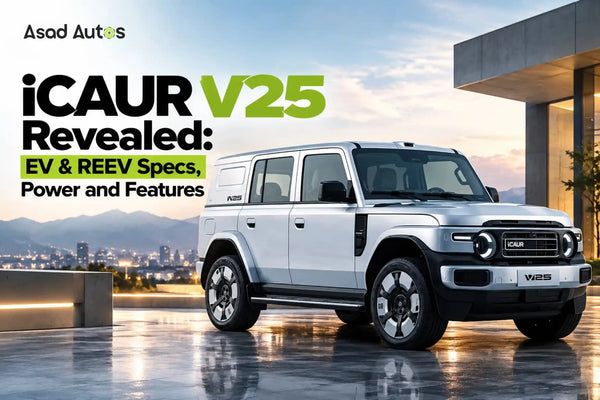
One detail deserves attention. The draft is reported to give battery electric, plug-in hybrid and range-extended electric vehicles equal status, which matters because REEVs are usually left out of Pakistani policy discussion entirely.
What the Ministry Has Already Published on EVs
Separately from the auto policy, the Ministry of Industries and Production's New Energy Vehicles Policy 2025-30 document sets out targets of its own.
It aims for 30% of new vehicle sales to be new-energy vehicles by 2030, roughly 2.2 million of them across 2025-30, most being two-wheelers. It also targets 3,000 public charging stations by 2030.
The nearer-term commitment is more concrete: 40 Level-3 fast chargers on the motorways and the N5 within six months of approval. Against what exists today, that is a significant jump, and our motorway and highway charging guide covers the current network.
That document also proposes reducing auto-sector tariff protection by 2030 and phasing out preferential sales-tax treatment for localised components, which is the same direction the draft auto policy takes.
What This Means If You Are Buying
Nothing has changed yet, and that is the useful conclusion. No duty in the table above applies to a car you buy this week.
Waiting is a judgement call rather than an obvious win. Prices on locally assembled models depend on far more than tariffs, and a policy five gates from notification is thin ground for postponing a purchase you need now.
For scale, Pakistan's vehicle population has passed 39 million, and if you are weighing an electric car specifically, our guide to buying an EV in Pakistan covers what to confirm before committing.
Final Thoughts
The policy is real, the direction is towards lower tariffs, more localisation and favourable treatment for electric vehicles, and the ambition on exports and production is genuine. None of it is law, and the Prime Minister's approval is roughly the halfway mark rather than the end.
Watch for one thing only: the Ministry of Industries notification. Until that exists, every duty rate and every target in circulation is a proposal, and the 112 days since the last policy expired are the best evidence of how long this stage can last.
15+ years in business · In-house fitting in Multan · Nationwide delivery · Exact-fit products, never universal
Questions about what fits your car? Contact us — 0321-1117525 · Open Mon–Sun, 9am–9pm.