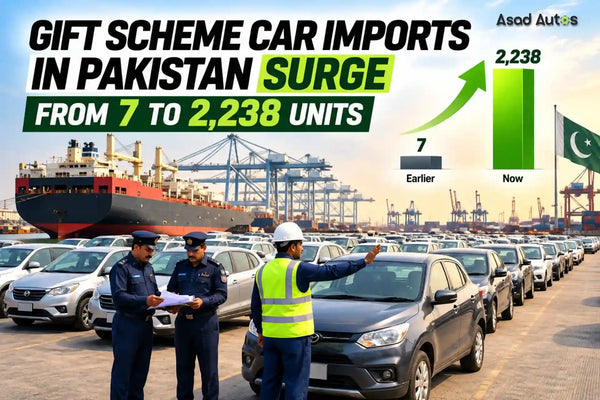
Pakistan's used car import scheme is in the news again, after Indus Motor Company raised concerns about misuse of the gift route.
This is a lobbying argument, so it deserves careful handling. Indus Motor assembles cars here and competes directly with imports.
That does not make its case wrong. It does mean the other side needs stating too.
And here is the interesting part. The government's own press release carries both arguments, and the official present chose the other one.
What Indus Motor Is Reported to Have Said
The company's chief executive is reported to have warned that the gift scheme is being misused.
Its argument runs like this. Cars brought in under a scheme meant for families reach the market as commercial imports instead.
That, the company says, weakens local assembly. It also argues it costs jobs, slows localisation and discourages investment.
Its asks are stricter enforcement, a predictable policy, rationalised duties, better car financing and export incentives.
Those are the company's stated positions, not established facts. We could not reach a government finding that the scheme is being misused.
The Government's Own Release Argues the Opposite
This is the part nobody is reporting, and it comes from an official document.
A government press release records a meeting between the Prime Minister's Special Assistant on Industries, Haroon Akhtar Khan, and an auto industry delegation.
Manufacturers made their case at that meeting. Their association warned that liberal import policies could erode the industry's gains.
But the state news agency's account records the government's reply too.
Khan said open competition would promote efficiency, and move the sector toward low-cost local manufacturing.
So the argument against protection is not an importer's talking point. It was made by the Prime Minister's own adviser, in a release headlined about protecting local industry.
What Is Officially Confirmed About the Rules
Less than you would hope, so we will be exact about what we could verify.
Khan stated that "only those used vehicles that meet safety and environmental standards will be allowed to enter Pakistan".
New legislation and regulatory frameworks were to follow on the Prime Minister's directive. Pre-shipment inspections were to verify safety and quality.
On commercial imports, the Secretary of Industries gave two concrete conditions. A three-year overseas residency requirement, and one year of registration in the owner's name.
That release gave no duty figures and no vehicle age limits. It also did not mention scheme misuse at all.
The Policy Has Changed Direction Three Times
Put the events in order and something clearer than any of them appears.
| When | What happened | Status |
|---|---|---|
| Dec 2025 | A new framework ordered, safety standards promised | Verified, official release |
| Jan 2026 | Personal baggage route removed, other schemes tightened | Reported |
| Jun 2026 | Import rules temporarily relaxed again | Reported |
| Oct 2026 | A manufacturer calls for stricter enforcement | Reported |
We could verify the first entry from government sources. The others come from press reporting.
That is at least three changes of direction in eleven months.
And it quietly supports one part of Indus Motor's case. The company asks for a predictable policy.
A timeline like that is better evidence for that request than any claim about misuse. Nobody can plan a factory around rules that move twice a year.
The Case for Allowing Imports
Put fairly, the argument for imports rests on three things.
Choice. Imports bring body styles, equipment levels and models that local assembly does not offer at all.
Competition. Protected markets are rarely cheap markets. The threat of an import is what keeps a local price honest.
Value. A well-kept used import can offer more equipment for the money than a new local car at the same price.
This is the position the government official took at that meeting. Competition, he argued, is what pushes local makers toward low-cost manufacturing in the first place.
The Case for Restricting Them
The manufacturers' case is also stronger than it is usually given credit for.
Investment needs certainty. A plant and a supplier base take years to build, and both assume predictable volumes.
Localisation is slow. Local parts manufacturing only develops when volumes justify the tooling.
Jobs sit downstream. Most automotive employment is in parts suppliers, not in the assembly plant itself.
And there is a consumer argument on this side too, which is easy to miss.
A locally assembled car has a parts and service network behind it. A one-off import often does not, and that cost lands on the second owner.
If You Are Thinking of Importing
Here we have to be blunt, because getting this wrong is expensive.
Do not rely on this article, or any article, for the current rules. We could not open the relevant notification to confirm them.
What we can tell you is that the position has moved more than once this year. The personal baggage route is reported to have been removed in January.
So check the current notification yourself, with the Ministry of Commerce and the Federal Board of Revenue, before you commit money.
Ask specifically about four things. Which schemes are open today. The residency and registration conditions. Any age limit on the vehicle. And the full duty and tax position.
Get it in writing, with a date on it. A rule that applied in June may not apply this month.
Final Thoughts
We are not going to tell you which side is right, because this is a genuine policy argument with real costs on both sides. A buyer wants choice and a fair price. A supplier wants the volume that makes local parts worth tooling for. Both of those are legitimate.
What is hard to defend is the churn. Three changes of direction in under a year serves nobody, and it is the one thing manufacturers and importers would probably agree on. The government's own adviser argued for competition rather than protection, which is worth remembering when this debate is framed as industry against imports.
For most readers the practical point is narrower. Verify the rules on the day, from the Ministry and the FBR, and keep a dated copy. Locally assembled cars like the updated Yaris remain the easier ownership proposition on parts alone. We are based in Multan and will tell you honestly when we have nothing exact-fit for an imported model.
15+ years in business · In-house fitting in Multan · Nationwide delivery · Exact-fit products, never universal
Questions about what fits your car? Contact us — 0321-1117525 · Open Mon–Sun, 9am–9pm.