Rising fuel prices are doing what policy could not: making electric vehicles in Pakistan pay for themselves faster. The target is for 30% of all new vehicles sold by 2030 to be electric, and the prime minister’s adviser on industries and production, Haroon Akhtar Khan, now says it will come much earlier. The number behind that claim is the one to watch: official estimates of EV payback have fallen from 22 months to between 12 and 18.
Pakistan Could Reach Its EV Target Ahead of 2030
Speaking to Bloomberg in early October 2026, Akhtar put it directly: “the target we had set in our electric-vehicle policy last year, we will achieve it much earlier.” Read that as an official expectation, not a revised target no new date has been published.
What the 30% target actually measures
This is where most coverage goes wrong. The government’s announcement of Pakistan’s National Electric Vehicle Policy 2025–30 says the aim is for “30% of all new vehicles sold in Pakistan by 2030” to be electric a share of new sales in that year, not of vehicles on the road, which turn over far too slowly. The release does not break it down by category either, so be wary of versions that apply it only to cars, or to cars and trucks. Those framings circulate, but they are not what the release says.
How Rising Petrol and Diesel Prices Change the Maths
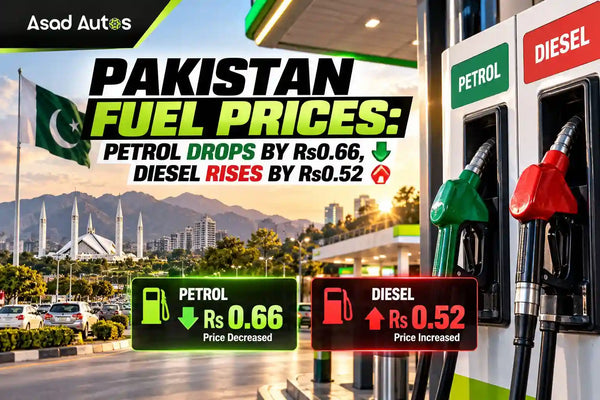
According to Pakistan State Oil figures cited in the latest report on Pakistan’s EV adoption target, petrol is up 54% and diesel 43% since conflict in the Middle East began in February. An EV’s economics turn on the gap between what you would have spent on fuel and what you spend on electricity — widen that gap and payback shortens without anyone changing a policy.
The payback period, then and now
Compare the government’s own two figures. In June 2025 the policy release put recovery at 1 year and 10 months, illustrated with an electric bike costing Rs150,000 more upfront. By October 2026 Akhtar put EV cost recovery at one to one-and-a-half years. That is 22 months down to 12–18 — between 18% and 45% faster.
Two cautions. The June figure is tied to an electric bike premium while the October one names no vehicle type, so they are not the same calculation. And payback is no promise to any buyer: it turns on the premium you paid, your annual mileage, your tariff slab and whether you can charge where you park. Our guide to buying an EV in Pakistan sets out what to check, and the EVs in Pakistan people buy against rising petrol costs show where the sums already work.
What the Policy Actually Contains
The policy is weighted towards two- and three-wheelers rather than cars, the realistic place to start here. An initial Rs9 billion subsidy for FY2025–26 was announced to facilitate 116,053 electric bikes and 3,171 electric rickshaws, a quarter reserved for women — roughly Rs75,500 per unit. Treat those as planned subsidised units, not sales: neither source publishes market-wide EV sales data.
The projections are large: 2.07 billion litres of fuel saved a year, close to $1 billion in foreign exchange, and capacity payments falling from Rs174 billion to Rs105 billion — a cut of about 40%. Official projections, not outcomes. On infrastructure it commits to 40 motorway charging stations averaging 105 km apart, mandatory charging points in new building codes, and battery-swapping schemes. Our survey of EV charging stations in Pakistan is the reality check on where the network stands now.
Possible EV Tax Incentives Under Consideration
Akhtar said the government is considering tax incentives to narrow the price gap with conventional vehicles, and that a new auto policy could reach the cabinet within two weeks. Both are proposals: nothing is approved and no measure or amount has been published. Do not time a purchase around an incentive that does not exist yet. What does exist is an exemption from customs duty and sales tax on EV parts, and the AIDEP tariff facility running to 2026 before phasing out by 2030.
What Would Actually Move EV Adoption in Pakistan
Our reading is that the fuel-price effect is real but narrow: it shortens payback for people already doing high mileage, and does nothing about the upfront price, which is what stops most buyers. That is why the two-wheeler end is where this target will be won or lost — a Rs150,000 premium on an electric scooter in Pakistan is recoverable on a commuter’s fuel bill in a way a car premium is not, and electric scooter prices in Pakistan have been coming down. Charging access is the other half: if you cannot charge where you park, none of the arithmetic applies. Watch the subsidy disbursements and the charging rollout, not the target date.
15+ years in business · In-house fitting in Multan · Nationwide delivery · Exact-fit products, never universal
Browse All Car Accessories →Questions about what fits your car? Contact us — 0321-1117525 · Open Mon–Sun, 9am–9pm.